Forget the Agentic loop, think agentic spiral.
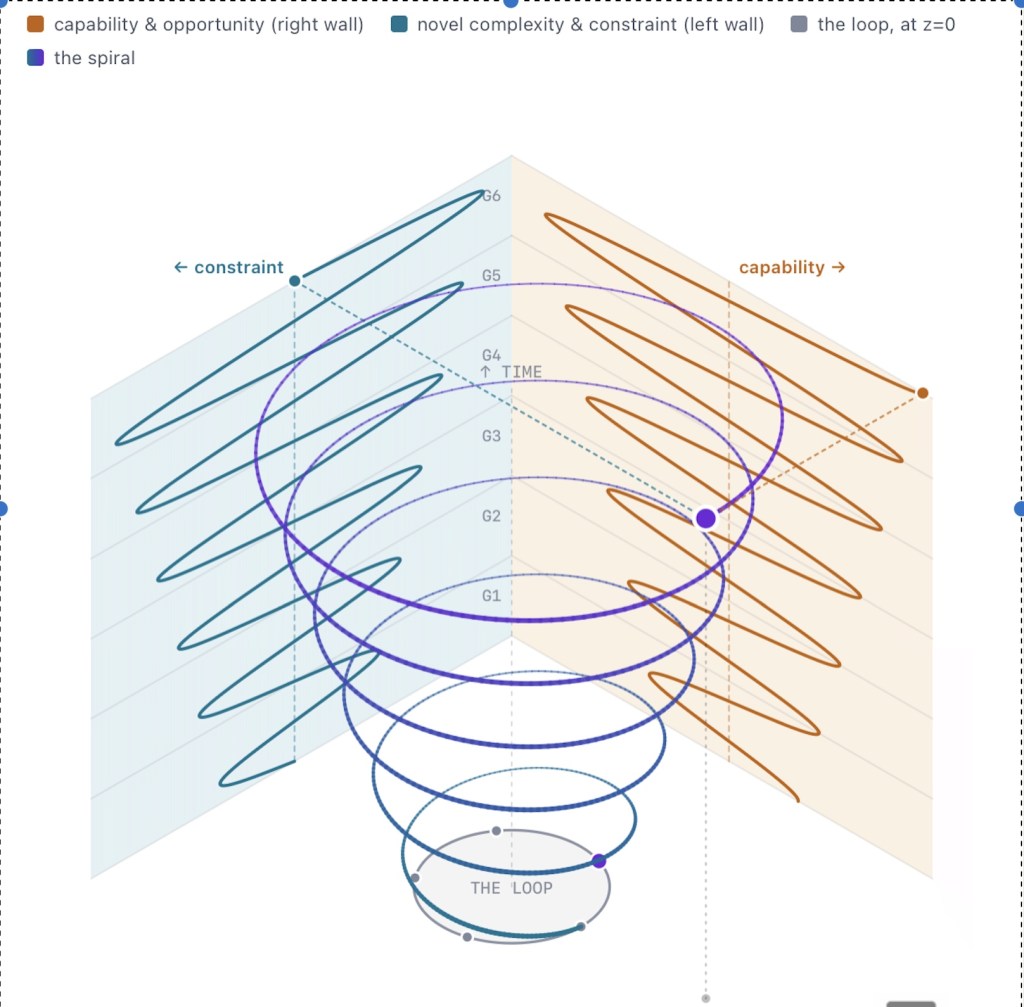
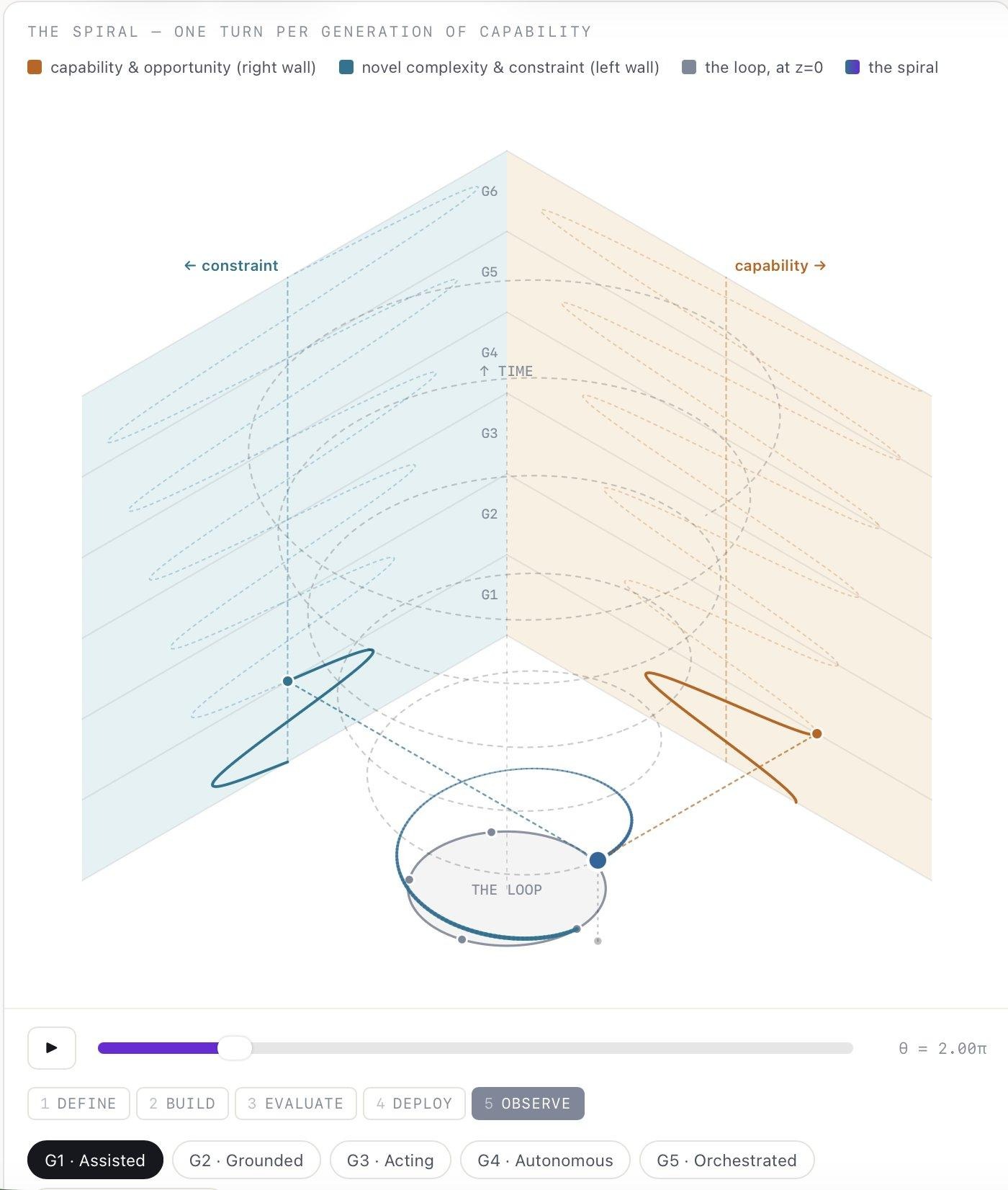
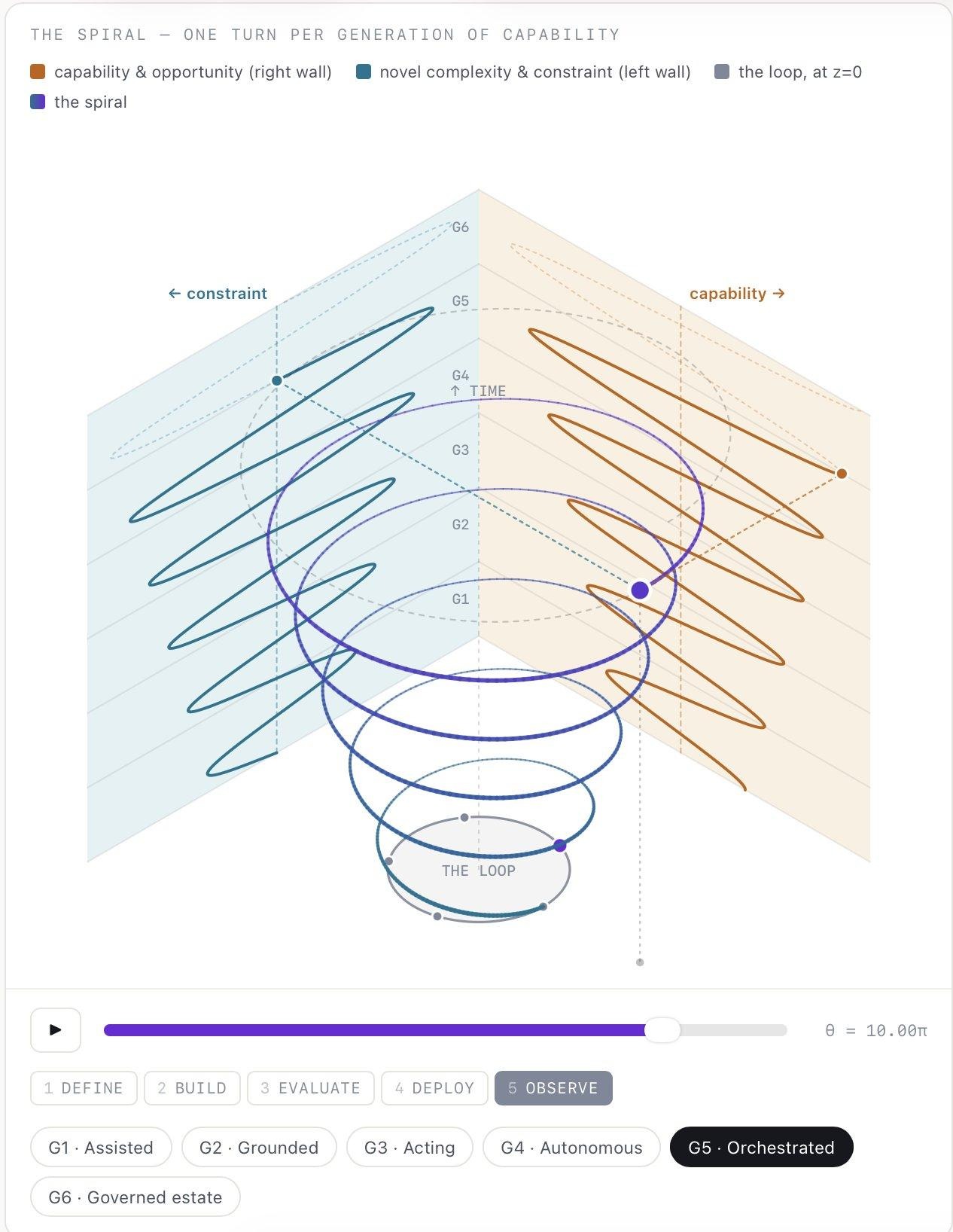
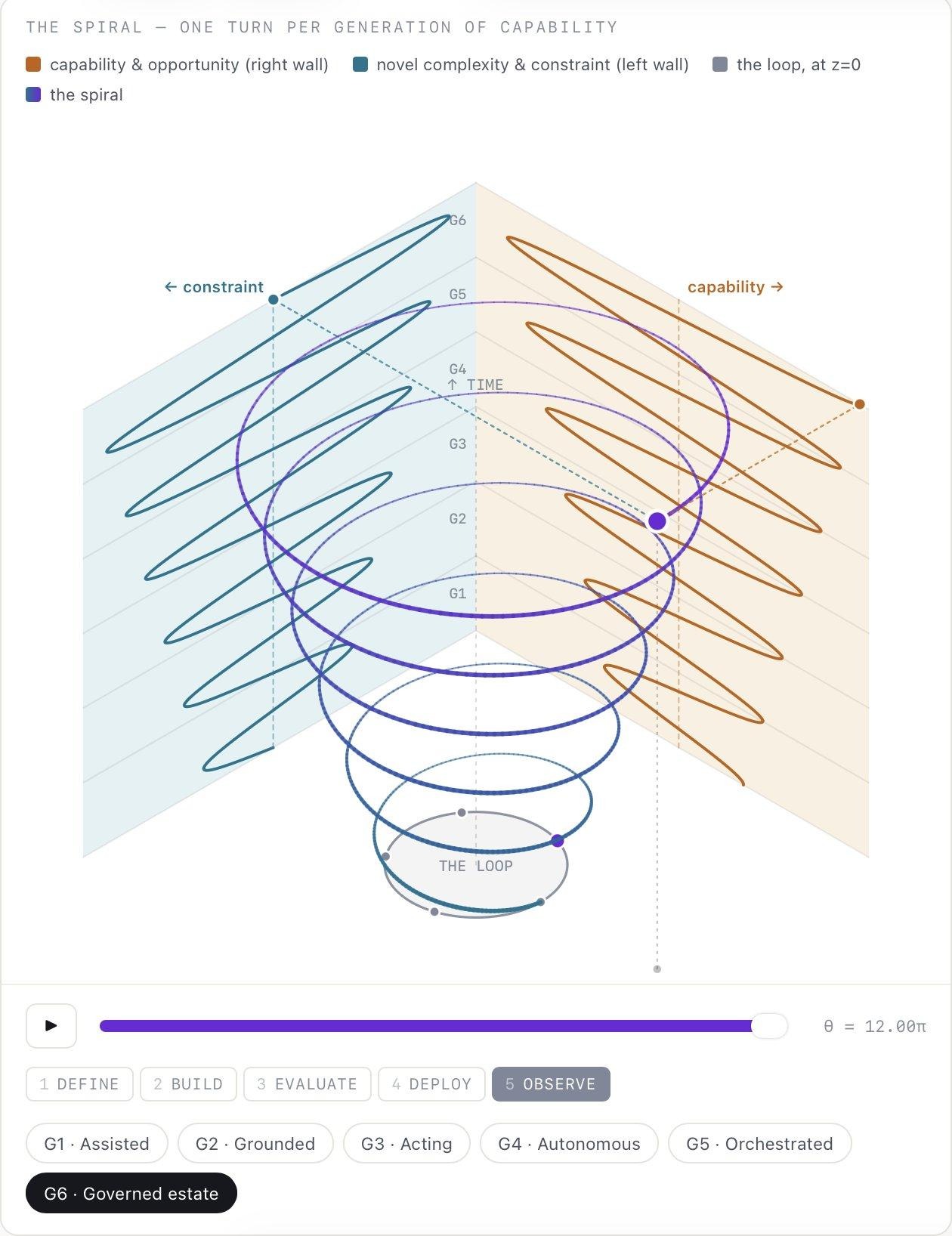
This article walks through an interesting pattern in Agentic AI development and explores its implications for the agentic enterprise and the people making it happen. It was inspired by a mathematician named Euler, who’s theory and equation shows how each turn around a circle actually describes a spiral, when plotted over time. This spiral casts a perpendicular shadow of Sine and Cosine waves on adjacent planes (see diagram) with the projected circle as the base.
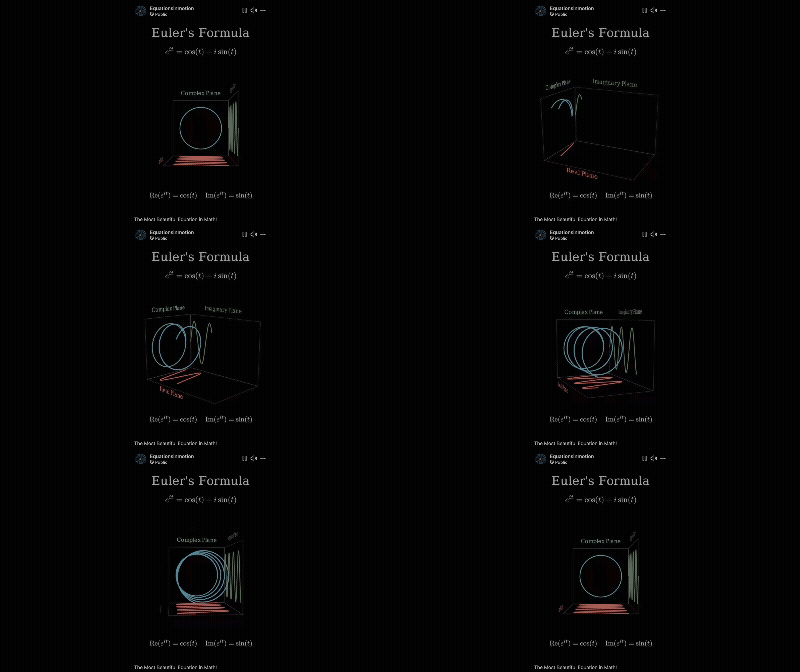
This visually decomposes the complex unit circle into its real (cosine) and imaginary (sine) components across three dimensions to show how they oscillate over time. It is considered the most beautiful equation in mathematics, and calls to mind the adage of how it’s impossible the same river twice, (because the waters you crossed the first time has moved on downstream).
But what has this got to do with agentic AI development, or emergning patterns?
How does this apply to Agentic AI?
Euler’s formula visualisation provides a great metaphor for describing agentic development lifecycle and its evolution. As every AI Builder knows (or should know!), the Agentic AI development lifecycle typically spans the following stages or some version of it:
- Plan / Define,
- Design / Build,
- Evaluate,
- Deploy
- Observe / Extend
You can imagine how an agent in development traverses each stage of the lifecycle.
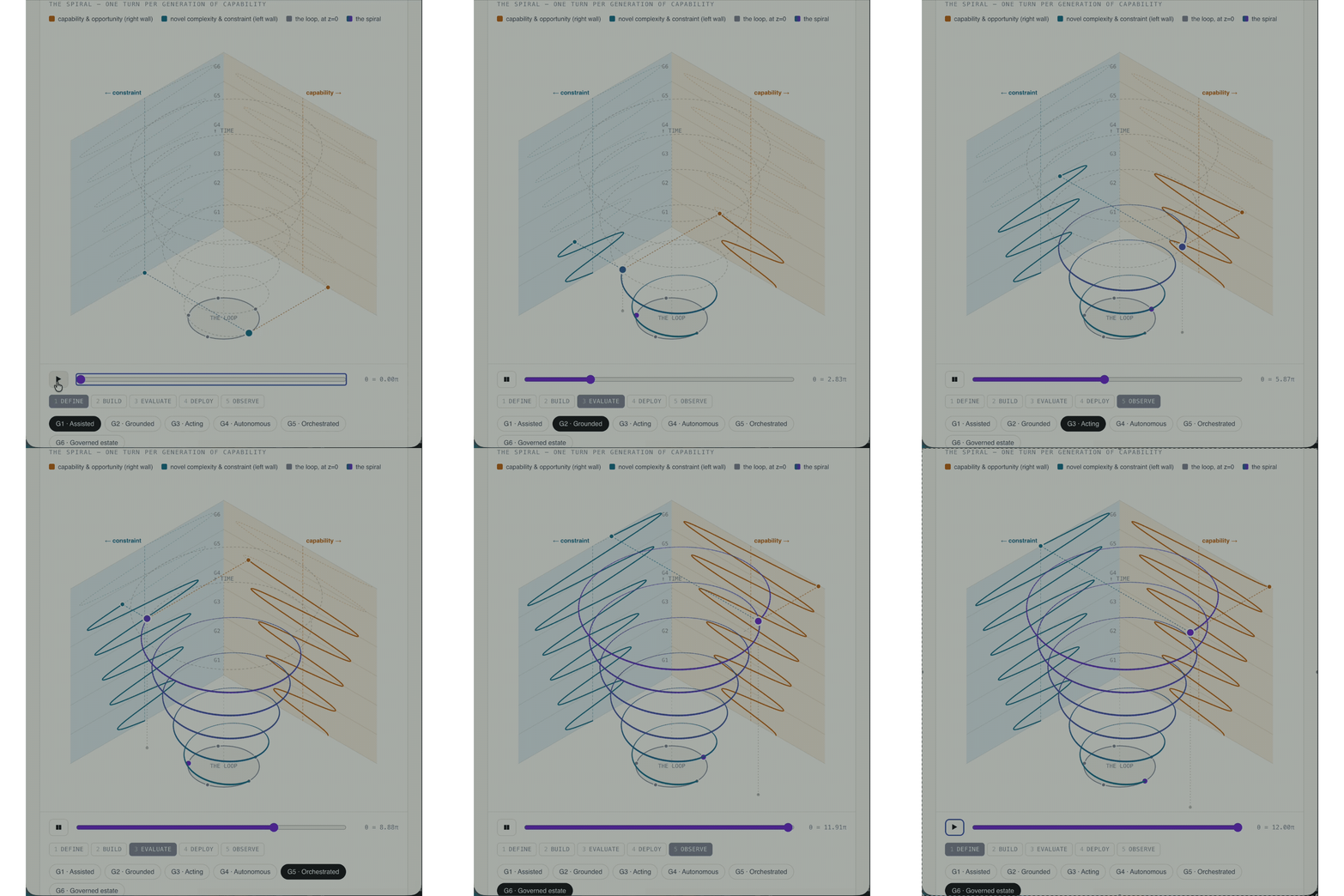
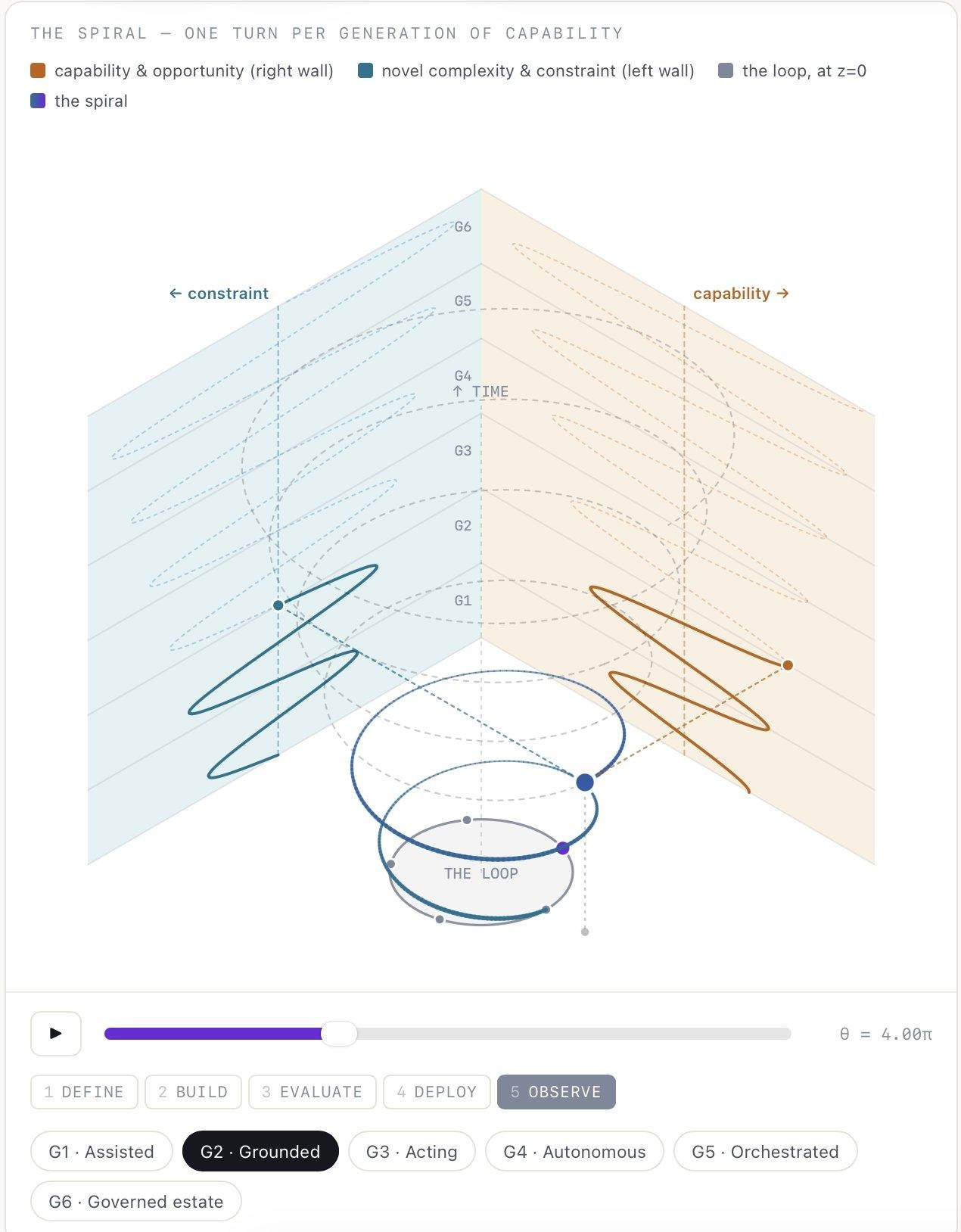
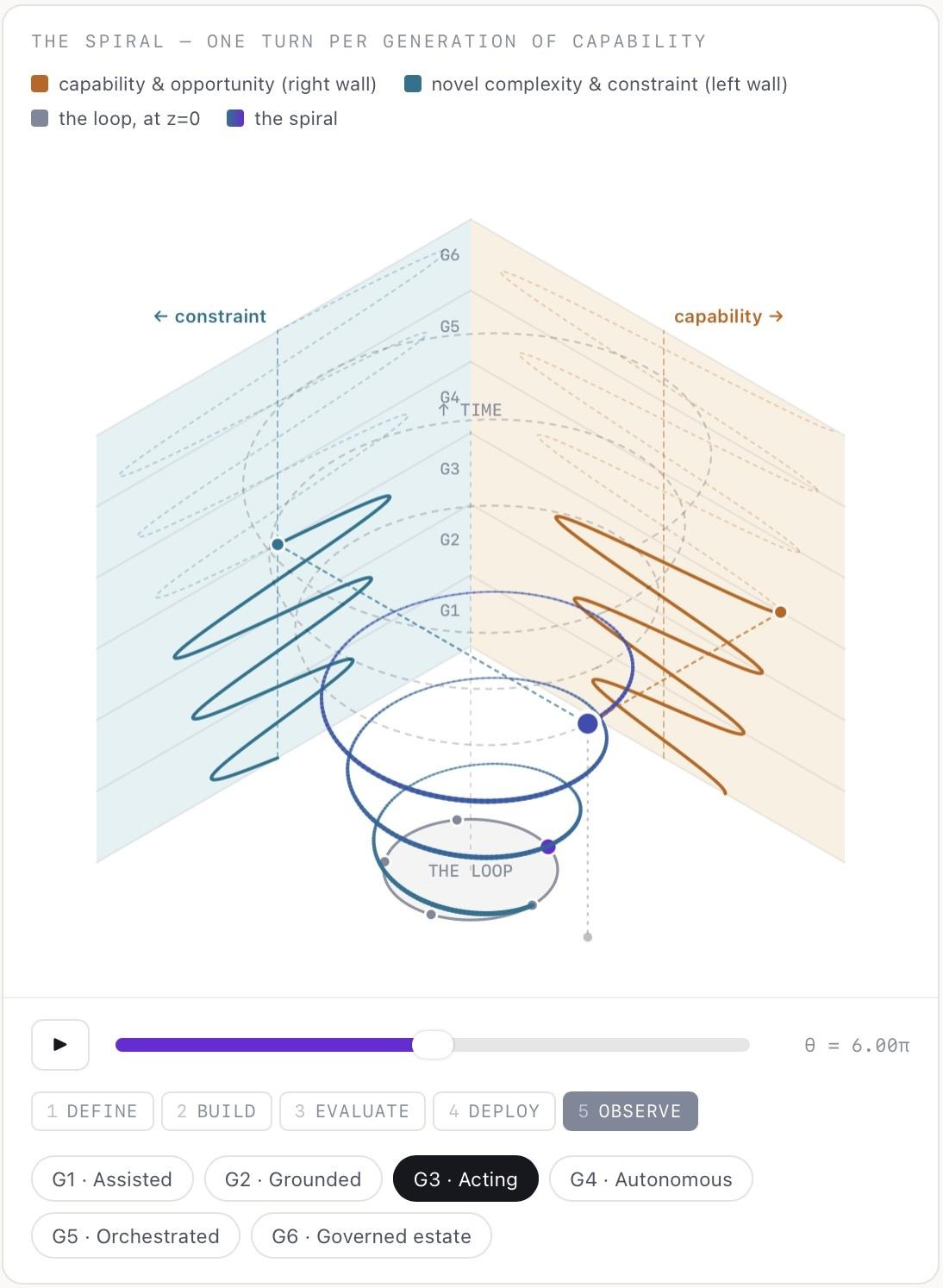
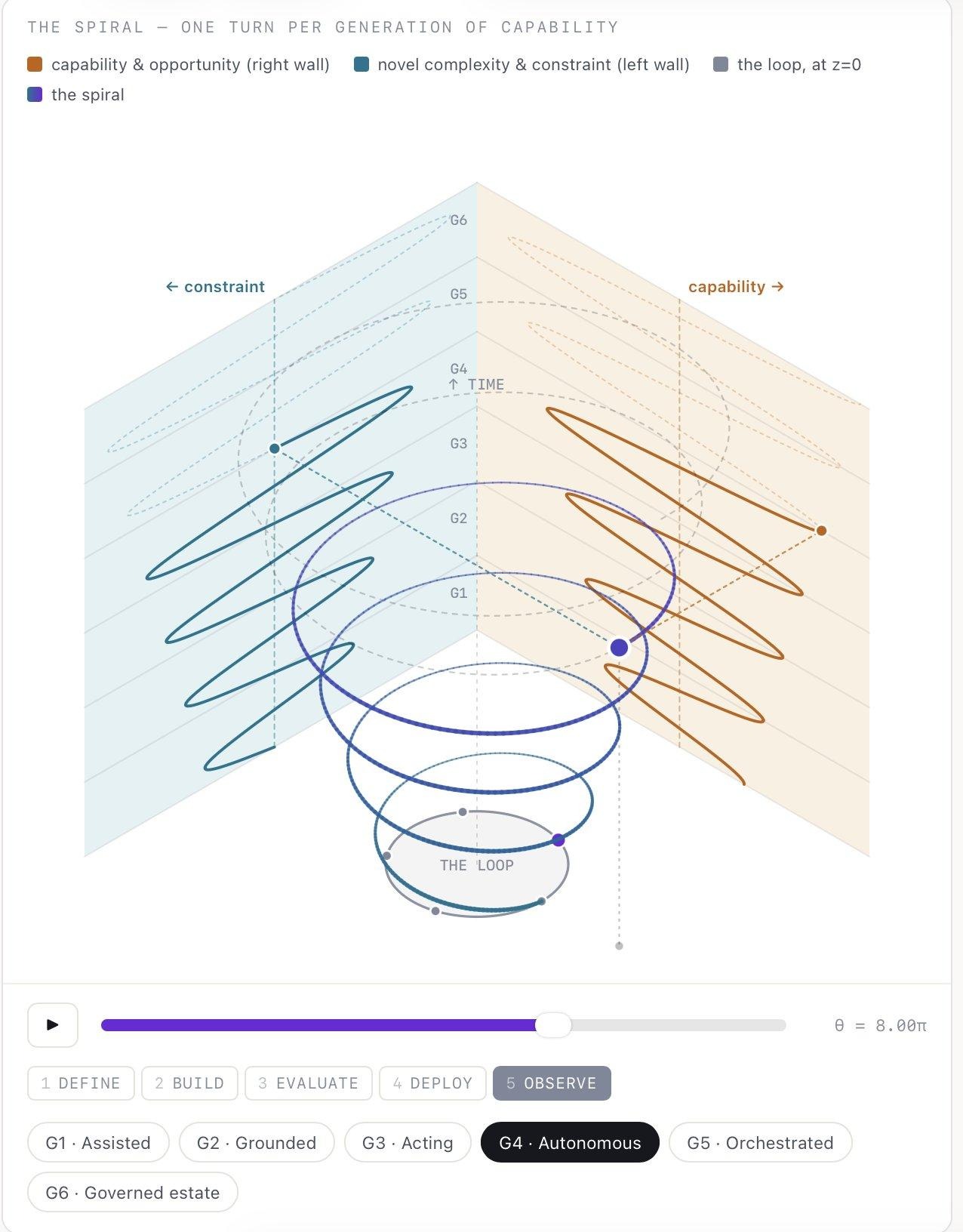
Over time, as the agent gains more capabilities, it will encounter novel challenges over and above existing ones. These capability lifts and related challenges are analogous to the sine and cosine waves on the formula’s real and imaginary plane. This animation shows how the agentic loop or development lifecycle evolves over time, much like Euler’s theorem.
Key Observations :
- The loop remains – each turn of the circle is a full cycle back to the start.
- Both shadows never go away they are sine and cosine of the same angle around the agentic loop – ship the new capability and you’ll get the challenges it brings
- The challenges lag by a quarter turn – if you think about it the challenges are introduced by the capabilities – e.g. think of voice creating challenges around accents
- Cone shaped blast radius (I prefer to think of this as splash zone) – th increasing with turn – i.e. net capability compounds but the impact of challenges also expands.
Lets Take It Step by Step
Lets take a closer look at the capability opportunities and related challenges of each stage of the agentic development spiral
GENERATION 1 – ASSISTED
A model in the conversation. Humans still do the work; the model shortens it.
EMERGING CAPABILITY & OPPORTUNITY
- Natural-language surface over systems people already use
- Drafting, summarising, classifying at near-zero marginal cost
- Fast to demo — days from idea to something convincing
NOVEL COMPLEXITY & CONSTRAINT
- Output can’t be verified — no source, no notion of truth
- Prompt fragility: behaviour shifts with wording and model version
- Value stays trapped in individual habit; nothing accrues to the org
ARCHITECTURAL CONSIDERATIONS
Treat prompts as versioned, tested artefacts — not config strings pasted into a field. Decide where the line sits between the model’s output and the system of record before anyone ships.
GENERATION 2 · GROUNDED
Retrieval arrives. The model answers about your business, not the internet’s.
EMERGING CAPABILITY & OPPORTUNITY
- Answers anchored in enterprise knowledge, with citations
- Domain specificity without retraining anything
- Content you already own becomes a live asset
NOVEL COMPLEXITY & CONSTRAINT
- Retrieval quality becomes the product — the model is now the easy part
- Stale, duplicated and contradictory sources surface as confident answers
- Permissions leak through the index: the retriever inherits every ACL you forgot to model
ARCHITECTURAL CONSIDERATIONS
Enforce access control at retrieval time, per identity — never by filtering results afterwards. Content lifecycle, ownership and freshness stop being a knowledge-management problem and become an architectural one.
GENERATION 3 · ACTIONS
Tools and writes. The agent stops describing work and starts doing it.
EMERGING CAPABILITY & OPPORTUNITY
- Reads and writes to systems of record — real transactions, real records
- Task completion becomes measurable, so value becomes attributable
- Work moves from the chat window into the workflow
NOVEL COMPLEXITY & CONSTRAINT
- Side effects are irreversible; a retry is not free
- Non-idempotent actions, partial failures, half-finished transactions
- Authorisation is now per tool, per caller — and blast radius scales with the toolset
- “What did it actually do?” becomes an audit question with a regulator attached
ARCHITECTURAL CONSIDERATIONS
Every tool needs its own authorisation, an idempotency key, and an audit record — no shared service account. Budget for the reversal path, not just the happy path: compensating actions, dry-run modes, and approval gates on anything you can’t undo.
GENERATION 4 · AUTONOMOUS
Planning, memory, self-correction. It runs while nobody is watching.
EMERGING CAPABILITY & OPPORTUNITY
- Goal decomposition across many steps and many systems
- Memory across sessions — context stops being re-explained every time
- Recovers from its own errors; handles the long tail you never specified
NOVEL COMPLEXITY & CONSTRAINT
- Non-determinism defeats conventional testing — the same input, two different runs
- Cost and latency vary per execution; unit economics become a distribution, not a number
- Memory drifts, carrying stale assumptions forward as fact
- Loops can run away — spend, steps and time all unbounded by default
ARCHITECTURAL CONSIDERATIONS
Move from assertion-based tests to evaluation: score distributions, tolerances, regression sets, and a golden path you re-run on every model change. Memory needs a schema, a TTL and a correction mechanism. Hard ceilings on spend, step count and wall-clock are runtime requirements, not ops hygiene.
GENERATION 5 · ORCHESTRATED
Agents calling agents — across teams, domains, and vendors you don’t control.
EMERGING CAPABILITY & OPPORTUNITY
- Specialisation and parallelism — narrow agents outperform one general one
- Cross-domain workflows that no single team owns end to end
- Composition: capability assembled, not rebuilt
NOVEL COMPLEXITY & CONSTRAINT
- Coordination overhead can exceed the gain — the classic distributed-systems tax, now non-deterministic
- Attribution across hops: which agent caused the outcome, and on whose authority?
- Trust boundaries with agents you don’t own; every hop is potentially hostile input
- Failures cascade and are hard to localise; behaviour emerges that nobody specified
ARCHITECTURAL CONSIDERATIONS
Observability must be causal and end-to-end — one trace per goal, not one log per agent. Agents need identity, explicit contracts, and delegated (not inherited) authority. Assume any inbound message may be adversarial, including from your own agents: validate at every boundary.
GENERATION 6 · GOVERNED ESTATE
Agents as an organisational asset class — discoverable, owned, governed, retired.
EMERGING CAPABILITY & OPPORTUNITY
- Reusable, discoverable agents: leverage compounds instead of being rebuilt per team
- Policy applied once, inherited everywhere
- The estate becomes plannable — capacity, cost and risk modelled like any other platform
NOVEL COMPLEXITY & CONSTRAINT
- Version and lifecycle sprawl: hundreds of near-duplicate agents, unclear owners
- Accountability and regulatory evidence — who is answerable for a decision the estate made?
- Model supply-chain risk: upstream changes ripple through everything at once
- Role and workforce change becomes the real constraint, not the technology
WHAT THIS FORCES IN THE ARCHITECTURE
A registry is non-negotiable: ownership, version, dependencies and blast radius per agent. Policy as code in the runtime path, not a document. Design the off-ramp on day one — deprecation, migration and decommissioning are the part everyone skips and everyone pays for.


Leave a Reply