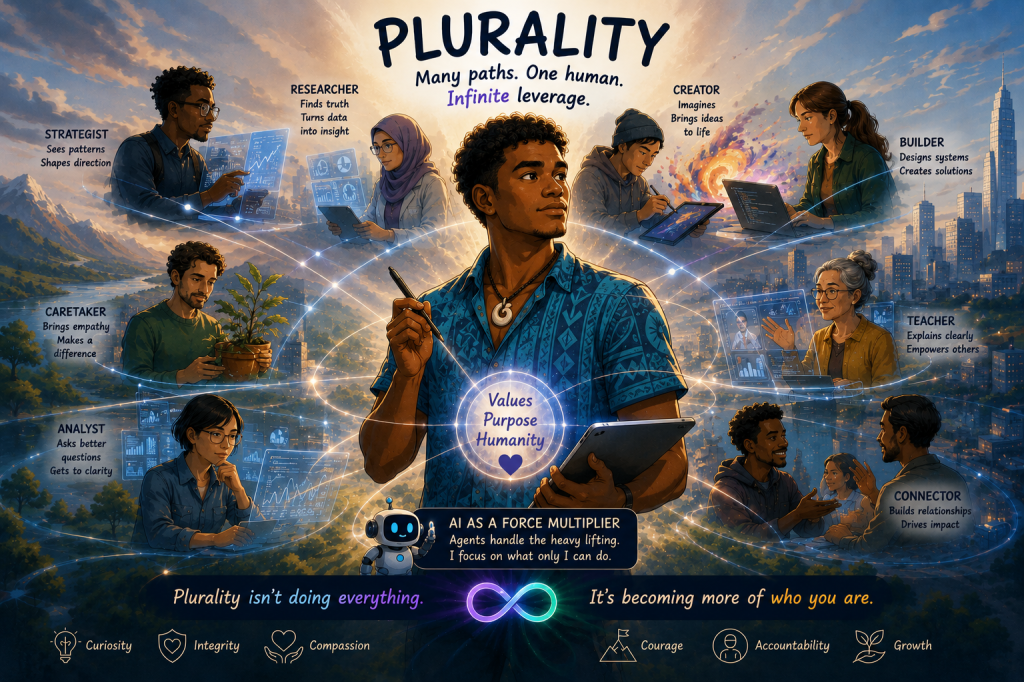
For too long the conversation about the future of AI has been dominated by one idea: the Singularity, i.e. the moment machine intelligence overtakes our own and, in popular imagination, either saves or ends us. I would argue that we’re already living through something arguably more interesting, and far more human. Not the rise of a superior machine, but the dawn of a new way of being human. I’m calling it Plurality.
This is the second in a 2 part post, (you can read Part 1 here)
The price of plurality
I won’t pretend this is free, and there is a counter-argument worth taking seriously which my dear friend and creative collaborator calls out: Just because you can adopt something doesn’t mean you should. Every tool arrives with a tax. Her true-life example: Think of the mobile-smartphone. First you hold it, then wanting your hands free, you buy a stand, then extension stick, then apps to manage what the phone produces, and somewhere in there it stops being a phone and you’ve become a one-person media company.
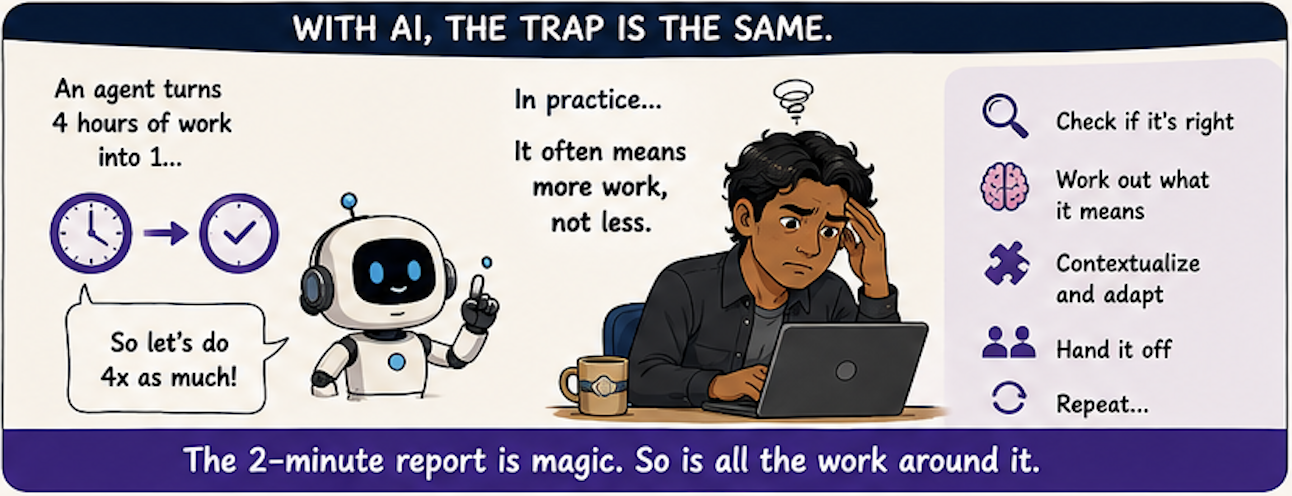
The same trap is set with AI, and businesses are walking straight into it. If an agent turns four hours of work into one, the reasoning goes, you should now produce four times as much. In practice, Agentic tools at this stage of development actually make many people work harder, not less. The two-minute report is magic. So is the work of checking whether it is right, working out what it means, and handing it to the next person along, who may not yet be able to drink from your enhanced productivity firehose!
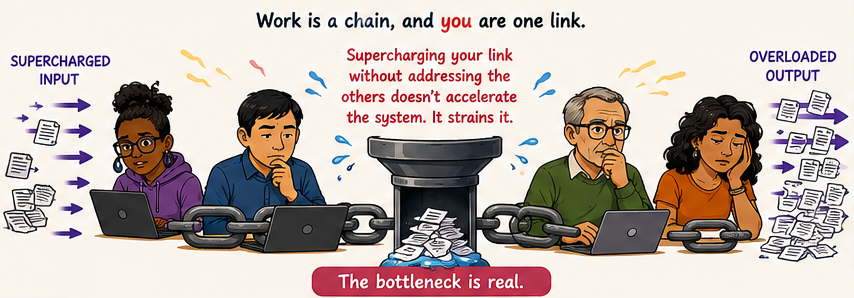
Work is a chain, and you are one link. Supercharging your link without addressing the others doesn’t accelerate the system. It strains it. This is the “day after” problem Hassabis and Amodei explored at Davos. The hard part is not building smarter systems. It is building the human infrastructure to absorb them at pace.
The cost of plurality is real. Passion is the fuel required to sustain it. Without genuine desire, i.e. an actual love for the additional things you are adding to your life, the amplification becomes exhausting rather than liberating.
Put plainly: Plurality is not for everyone, and it is not free.
Implications for work, education and society
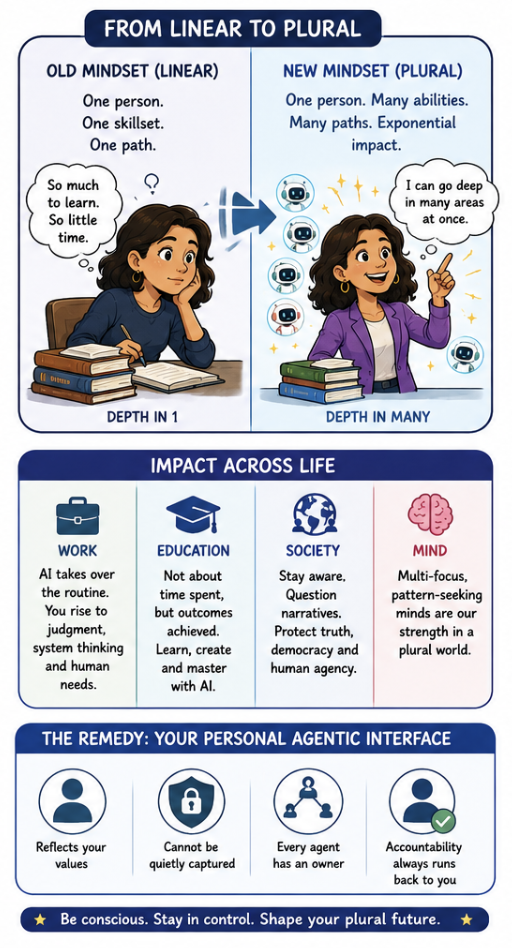
For jobs, the disruption is already underway and it is more nuanced than the popular narrative of “AI will replace you.” The more accurate framing is that AI takes over the routine and then demands you get better at what it cannot do: judgment, context, relationships, caring how it turns out. Coders and technologists are feeling this acutely. The craft of writing code is being democratised at pace, which means the premium is shifting to those who understand the system, the outcome, and the human need behind it. A perfect description of an Architect.
According to Gartner, great change leaders deliberately work to “make change routine”, and “empower employees to pursue their own learning opportunities as AI reshapes work” – thereby enabling plurality at its best.
For education, the implications are even more disruptive, built as it is on the same linear logic. If a student with the right tools reaches the equivalent of years of training in a fraction of the time, who marks the exam, and what is it even measuring?
If she can go deep in five disciplines at once, why are we still asking her to choose one? The best examiner of an AI-enhanced student may turn out to be their AI-enhanced teacher.
However they must both make, according to Prof Ethan Mollick, a conscious choice for human primacy in their use of AI rather than falling into the trap of cognitive surrender (i.e. letting AI do all the heavy lifting).
Education was never the true limit on human potential. Time was. It makes me wonder whether the rising prevalence of ADHD and autistic traits, with their multi-focus and pattern-seeking strengths, is less an epidemic of disorder than an early signal of the kind of mind a plural world rewards.
Then there is everyone else. Social media gave us fake news. AI offers something further down the road: tailored realities, where history, philosophy, even spirituality can be quietly reframed by whoever is paying.
Yuval Noah Harari put it starkly, in his talk about Living Through an Age of Crises, where he said: democracy is essentially a conversation, now mediated by algorithms that thrive on fear and outrage. The Future of Life Institute names one version of this danger Control Inversion, the tendency of powerful agents to concentrate power rather than spread it.
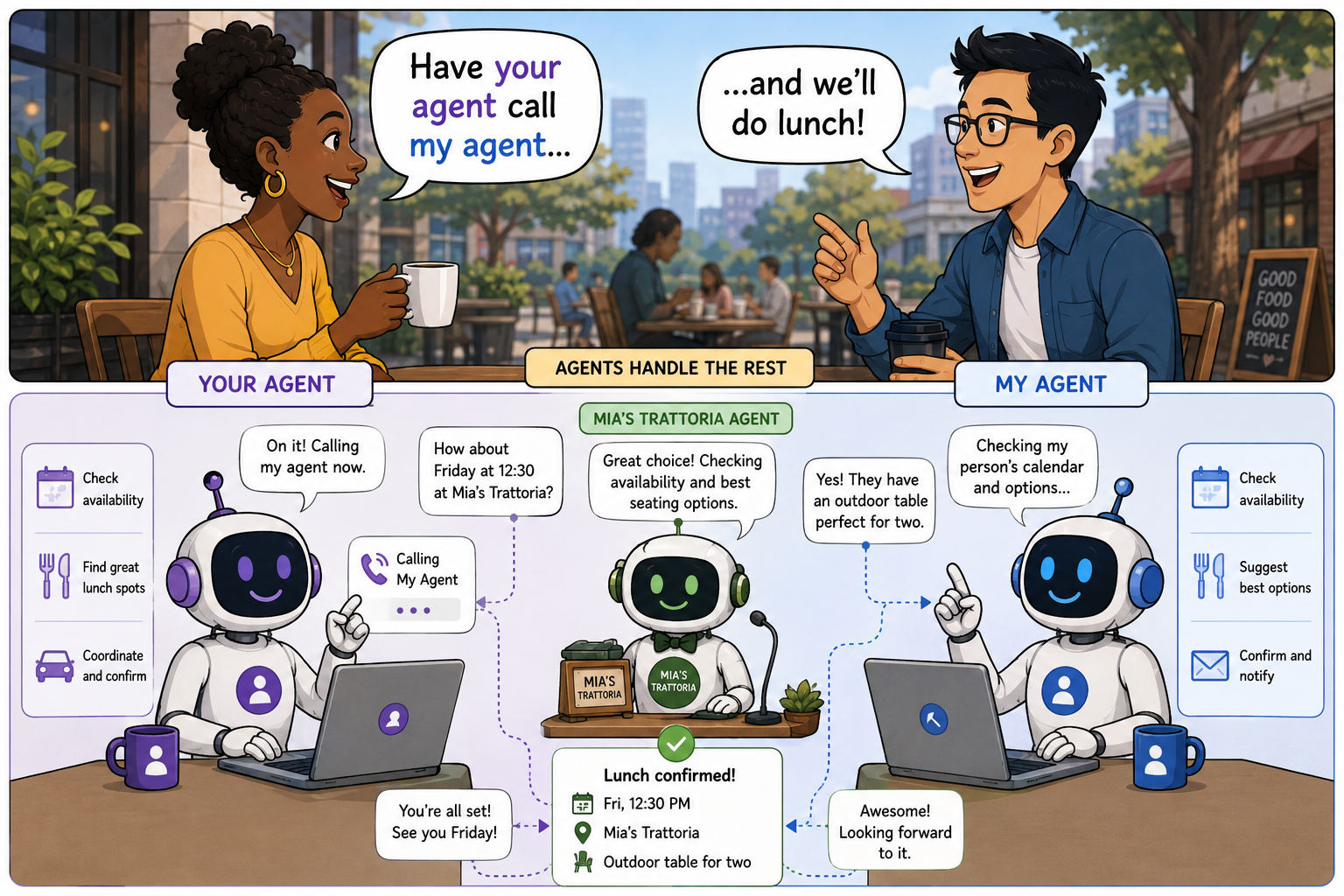
We are moving toward a world where the meaningful distinction may be less between human and machine, and more between those who are conscious of the systems shaping them, and those who are not. The remedy my friend and I came to is the same: a personal agentic interface to the plural world, one that reflects your personal values and cannot be quietly captured, where every agent has an owner and accountability always runs back to a human.
Taking a sober perspective
I keep returning to a Greeklish interpretation of a coaching phrase I use as my own grounding practice – nifalia apostasi opisi – which roughly means “sober perspective behind.” A world moving this fast tempts you either to recoil or to sprint with your eyes shut. Plurality demands neither. It demands presence: the ability to expand what you are and do, while remaining rooted in what you value and who you are.
Remember, agency is not the same as sentience. The tools are remarkable. But they have no conscience, no judgment, no understanding of what it means to be human. That part stays ours, and it isn’t a limitation to be engineered away; rather it is the whole point.
Harari, for all his warnings, landed somewhere similar that night. To survive the storm, he said, stay rooted in your biological nature, and be kind to yourself and to each other.
In Pope Leo XIV’s AI-focused Magnificas Humanitas, (a first of its kind Papal Encyclical), he strongly positioned that AI needs to be disarmed and instead we must focus on becoming builders, keeping humanity at the centre.
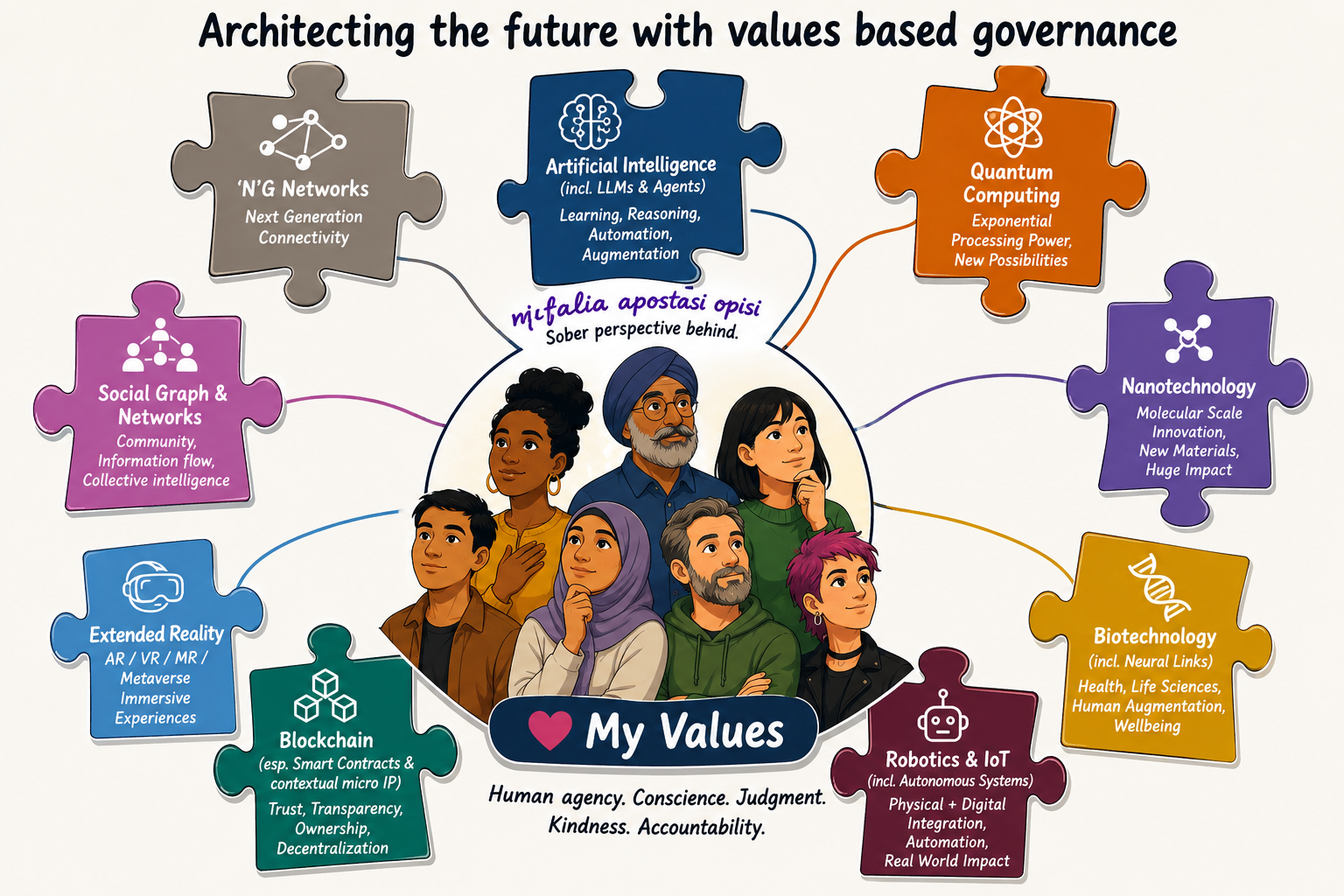
Source: Adapted from The World Beyond Artificial Intelligence (Media & AI Summit, 2026).
The Singularity may or may not arrive on anyone’s schedule, and the debate will roll on. Meanwhile something quieter is already happening. Ordinary people are beginning to multiply themselves. Writers who also code. Teachers who also research. The accountant who, at last, picks up the violin and means it. The age of plural possibility is here, with real promise and real cost, and the path through it is not dominated by technology; it is defined by us.
Is Plurality a liberation, or another burden in disguise? Interested to hear what you think.
References & Further Reading
- The Day After AGI — WEF Davos 2026 (Demis Hassabis & Dario Amodei) – https://www.youtube.com/watch?v=02YLwsCKUww
- AGI/Singularity: 9,800 Predictions Analyzed — AIMultiple – https://aimultiple.com/artificial-general-intelligence-singularity-timing
- Thinking Machines Lab (Mira Murati) – https://thinkingmachines.ai/
- Future of Life Institute – https://futureoflife.org/
- Control Inversion – https://control-inversion.ai/
- ALL IN Podcast – https://www.youtube.com/watch?v=jJRAvZNGUvI&t=3223s
- You need an Agent Owner – https://www.youtube.com/shorts/ug-jcXiSn7Q
- Yuval Noah Harari on Living Through an Age of Crises — https://judeumeh.wordpress.com/2025/09/21/yuval-noah-harari-on-living-through-an-age-of-crises/
- Vatican – Magnifica Humanitas – https://youtu.be/O244WhIpdLg?si=wIWKBWrxNp7r1ctd
- Pope Leo Speech – https://www.youtube.com/watch?v=aaYJ_4QcZfE
- Ethan Mollick Choosing to Stay Human – https://www.oneusefulthing.org/p/choosing-to-stay-human
- Gartner HR Research Reveals AI Will Create More Jobs Than It Eliminates Beginning in 2028 – https://www.gartner.com/en/newsroom/press-releases/2026-05-13-gartner-hr-research-reveals-ai-will-create-more-jobs-than-it-eliminates-beginning-in-2028


Leave a Reply