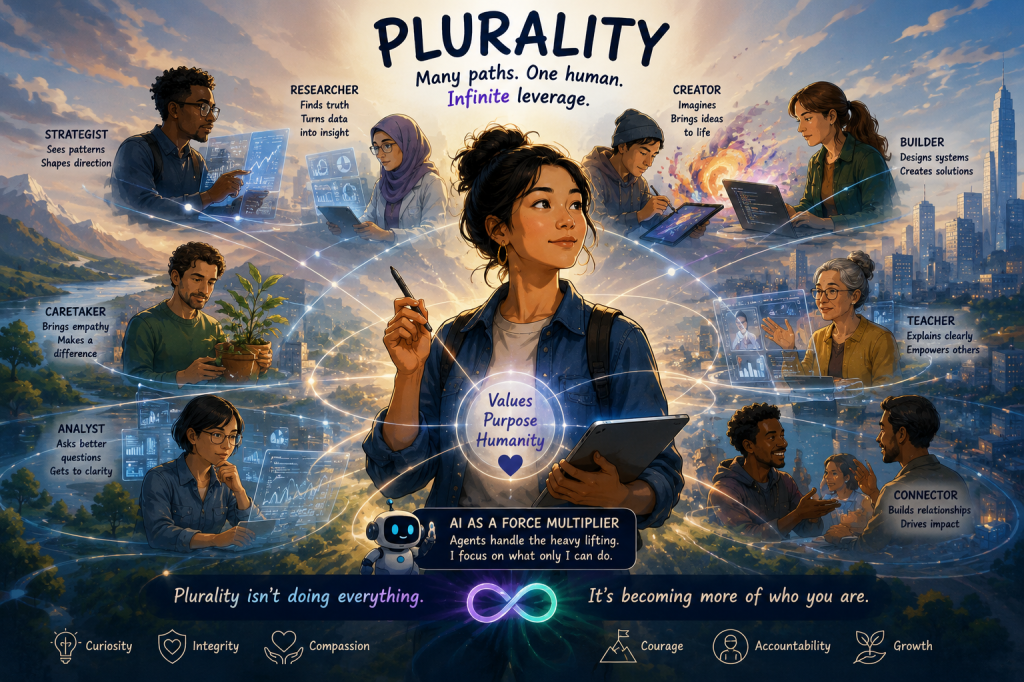
For too long the conversation about the future of AI has been dominated by one idea: the Singularity, i.e. the moment machine intelligence overtakes our own and, in popular imagination, either saves or ends us. I would argue that we’re already living through something arguably more interesting, and far more human. Not the rise of a superior machine, but the dawn of a new way of being human. I’m calling it Plurality.
This is the first in a 2 part post on this topic.
Asking the wrong question
The Singularity debate is real, and the clocks are speeding up. At Davos 2026, in a session pointedly titled The Day After AGI, Dario Amodei of Anthropic and Demis Hassabis of Google DeepMind, (two of the people actually building these systems), agreed on the shape of the near future: i.e. AI that plans, acts, and improves its own work is already here. Hassabis calls the coming change “ten times the Industrial Revolution, at ten times the speed.”
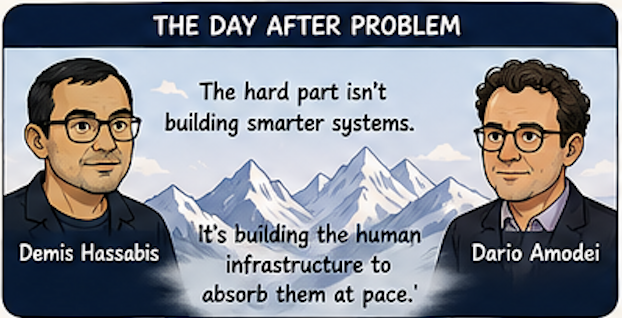
However you think about it, the question of when machines will become smarter than humans makes for a stimulating but circular debate. The real question that will actually shape the decade is quieter. What will ordinary people do with tools that multiply what they can already do?
The answer to that question is already emerging.
Moving from linear to plural existence
For most of human history, existence has been fundamentally linear. You are born, you are shaped by circumstance into a particular path, and you follow it. Our institutions assume as much. School moves a child from primary to secondary to university, toward a professional identity: e.g. doctor, lawyer, engineer etc., and that is what you became.
However, the human brain is elastic, restless and enormously capable of variety; not designed for a single track. We go home from the job that pays the bills and we paint, compose music, coach our children’s football team, write novels etc. But those other selves have always run at a low setting, constrained by time and money and the plain fact that you get one life and one set of hours.
Time, not talent, has always been the cage. That cage is what generative AI and agentic systems have begun to unpick. The shift is not automation. It is amplification.
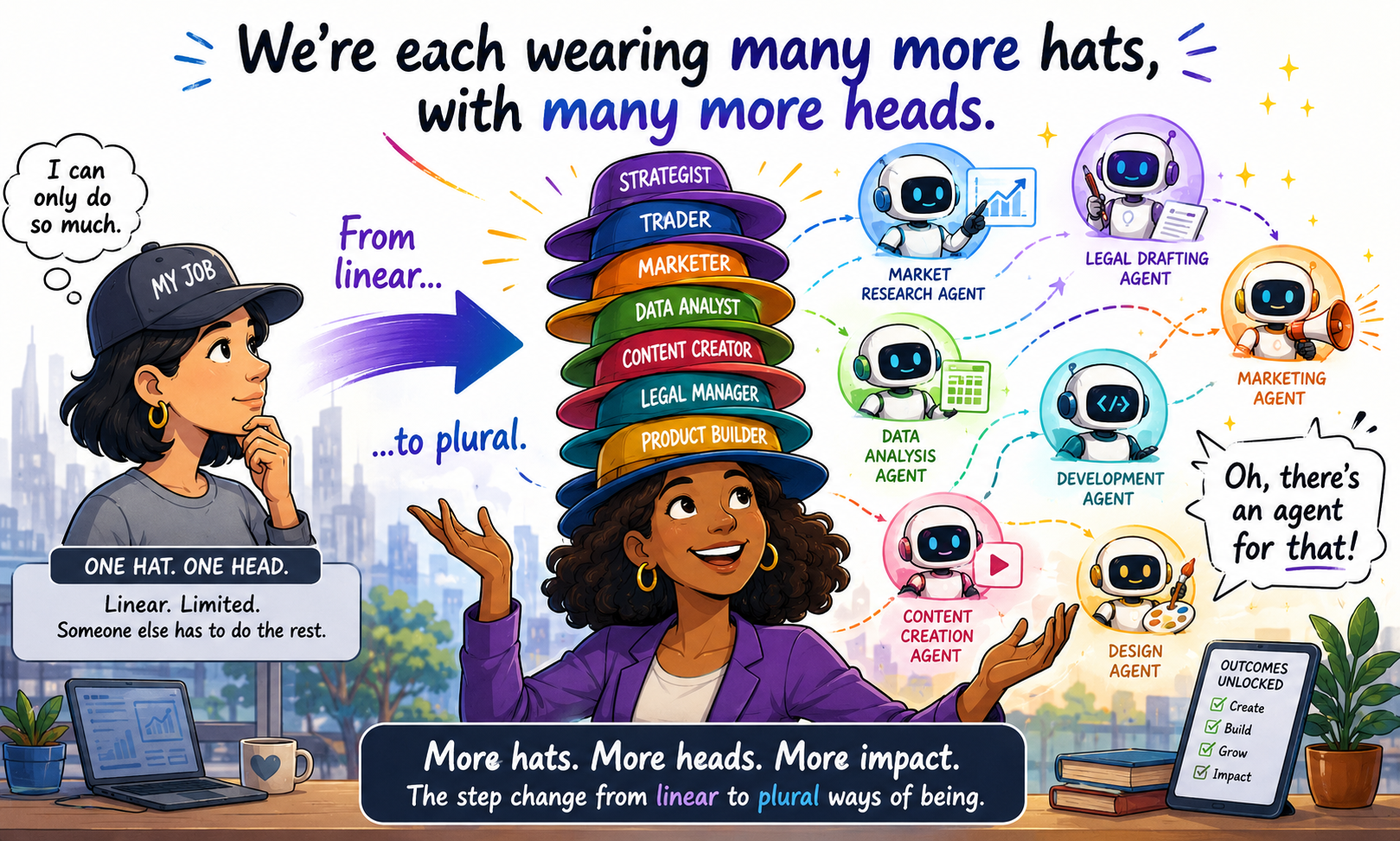
For the first time you can reach into capabilities, disciplines, and creative domains that were previously inaccessible, without years of dedicated study, and produce outcomes of remarkable quality. Standing on the shoulders of giants used to be a privilege of the formally educated. It is becoming an option for anyone with a laptop and genuine curiosity.
That is Plurality: i.e. the ability to be and do more than one thing at a time, (not superficially, but substantively), augmented by AI. A step change from a linear way of being to a plural one.
The evidence is already here
The signs are unmistakable. We have moved from single AI models to multi-agent frameworks, where diverse agents collaborate in pipelines, sometimes without human prompting. Vibe coding, (the practice of building software through natural language conversation) has turned curious non-engineers into people who ship working software. The now familiar refrain is: “oh, there’s an agent for that”.
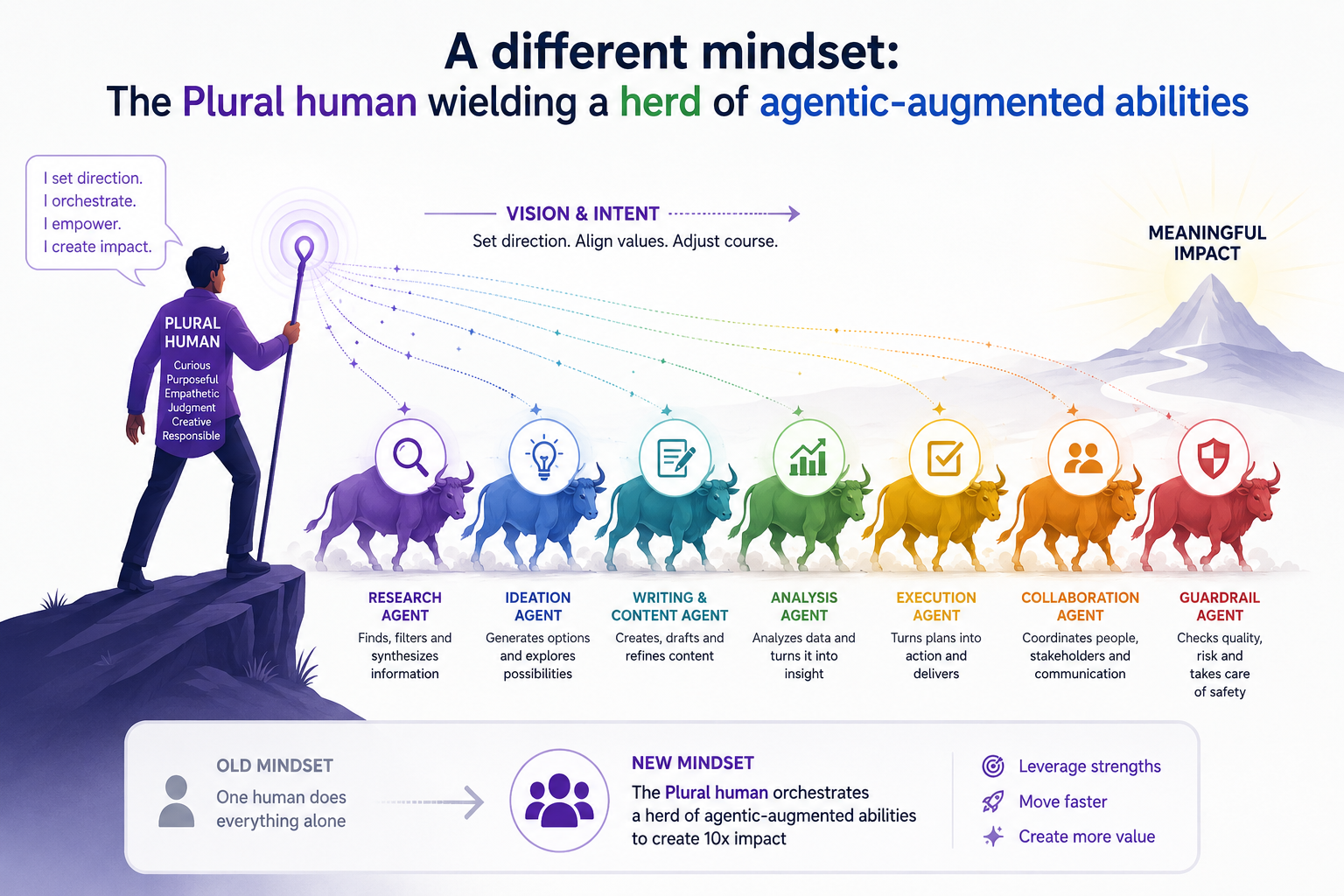
But the more profound shift is personal, not technological. These tools do not give you the hours. They give you the outcome equivalent of someone who has put in the hours, and your job is knowing to ask the right questions. The role of a Forward Deployed Engineer (FDE) embraces this by working closely with clients to custom build specific AI solutions for their particular context. This is true human-AI partnership.
Who, you might ask, is building the next version of this? Thinking Machines Lab founder, Mira Murati (ex-CTO of OpenAI), is explicitly set against fully autonomous AI, aiming instead for multi-sensory systems that “adapt to the full spectrum of human expertise” and work with people rather than replacing them. Read that twice. It is, in effect, a technical blueprint for Plurality. Now we’re talking!
BTW. Check out an All-In Podcast segment discussing the huge implications of this move with guest Marc Benioff.
Part 2 of this piece examines the price of plurality, key implications and a sober perspective.
References & Further Reading
- The Day After AGI — WEF Davos 2026 (Demis Hassabis & Dario Amodei) – https://www.youtube.com/watch?v=02YLwsCKUww
- AGI/Singularity: 9,800 Predictions Analyzed — AIMultiple – https://aimultiple.com/artificial-general-intelligence-singularity-timing
- Thinking Machines Lab (Mira Murati) – https://thinkingmachines.ai/
- Future of Life Institute – https://futureoflife.org/
- Control Inversion – https://control-inversion.ai/
- ALL IN Podcast – https://www.youtube.com/watch?v=jJRAvZNGUvI&t=3223s
- You need an Agent Owner – https://www.youtube.com/shorts/ug-jcXiSn7Q
- Yuval Noah Harari on Living Through an Age of Crises — https://judeumeh.wordpress.com/2025/09/21/yuval-noah-harari-on-living-through-an-age-of-crises/
- Vatican – Magnifica Humanitas – https://youtu.be/O244WhIpdLg?si=wIWKBWrxNp7r1ctd
- Pope Leo Speech – https://www.youtube.com/watch?v=aaYJ_4QcZfE
- Ethan Mollick Choosing to Stay Human – https://www.oneusefulthing.org/p/choosing-to-stay-human
- Gartner HR Research Reveals AI Will Create More Jobs Than It Eliminates Beginning in 2028 – https://www.gartner.com/en/newsroom/press-releases/2026-05-13-gartner-hr-research-reveals-ai-will-create-more-jobs-than-it-eliminates-beginning-in-2028


Leave a Reply